Blue Book Agency
2a perrymead street
London
SW6 3SP
Goulds Ground, Frome
£2,250,000










6 Bedroom House - Detached
- Grade II* former rectory, built in 1818, in the centre of the thriving market town of Frome.
- Defined by light and airy rooms, with period fireplaces and timber floors.
- Perfect house for family life and entertaining.
- Generous and private walled gardens frame the house.
- Stone parking area with garages, providing private parking for several cars.
- Excellent transport links, with trains to London from Westbury, Warminster and Frome station.
A fine Grade II* former rectory in this peaceful setting in the centre of the thriving market town of Frome.
Built in 1818 and believed to be designed by the architect John Pincher the Elder (1769-1827), who has been credited with many of the finest buildings in the Bathwick area of Bath and the renowned nearby Babington House.
Why We Love Fountain House
A fine Grade II* former rectory in this peaceful setting in the centre of the thriving market town of Frome.
Built in 1818 and believed to be designed by the architect John Pinch the Elder (1769-1827), who has been credited with many of the finest buildings in the Bathwick area of Bath and the renowned nearby Babington House.
The model of Regency chic, Fountain House has been sensitively restored under the guidance of our clients’ artistic eye with a meticulous attention to detail. The result is a beautifully serene home which has the proportions and relationship to its outside space which one would expect in a country house but with the convenience of a location in town.
Defined by light and airy rooms, the house has large sash windows with shutters, period fireplaces and timber floors. The ground floor rooms all flow very well making a perfect house for family life and entertaining.
Downstairs
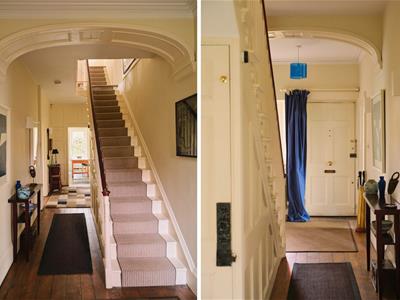
The front door with its Tuscan porch and flanking holly bushes, opens into the central entrance hall with stained-glass window and staircase with mahogany rail.
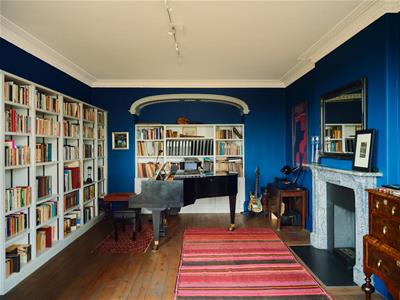
The first well-proportioned room lends itself to use as a music room or library painted in rich royal blue with ornate marble fireplace, extensive inbuilt bookshelves and timber floor. Used differently of course it could be a playroom or a separate formal dining room. The study across the hall enjoys dual aspect windows, overlooking the front and rear gardens as well as fitted bookcases and an open fire.
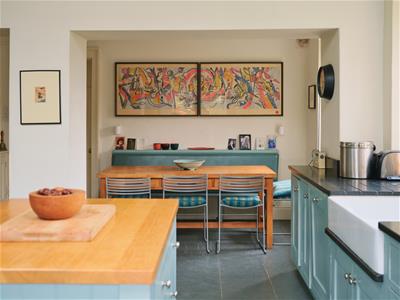
The dual aspect drawing room with stunning bay window and period fireplace with working fire, overlooks the glorious garden and Holy Trinity Church beyond, which is home to nine Burne-Jones windows. Perfect for entertaining, the room has an open archway which leads through to a formal dining area with glazed doors leading from both spaces out onto a garden terrace . The traditionally inspired modern kitchen, is an airy and uplifting space courtesy of a high vaulted ceiling with skylights and triple aspect windows with French doors onto another generous outdoor dining terrace. The room has a smart stone floor and is fitted with bespoke cabinetry with granite countertops, double butler’s sink and island to one end and a breakfast area with large dining table to the other. A downstairs cloakroom with attractive wallpaper and tall over-door window completes this floor.
The cellar provides extensive storage with room for additional fridge freezers, wine storage, boiler room and store.
Upstairs
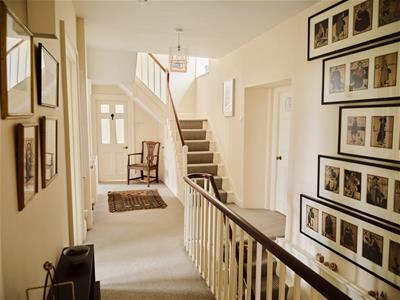
The magnificent principal bedroom is situated on the first floor. This fantastically generous and bright space includes a big bay window overlooking the formal garden, an original fireplace and jib door to a further bedroom. There are three further double bedrooms on this floor, a dressing room with inbuilt cabinetry, two smartly appointed family bathrooms, and a linen store.
There are two additional bedrooms at the top of the house, each accessed via its own staircase. One of these bedrooms is dual aspect with fireplace, balcony, and adjoining bathroom. The other room is currently used as a study and has a fireplace and extensive inbuilt cupboards. Both spaces have spectacular views for miles around.
Private Walled Garden
One of the most remarkable things about Fountain House is its exceedingly generous and private walled gardens which encompass and frame the house.
A gate at the front of the house leads onto a private stone parking area with garages, providing private parking for several cars. To one side of the house, a large stone terrace, edged with lavender bushes, overlook the extensive walled formal garden. With sweeping lawns, and herbaceous borders stocked with mature trees, a wide assortment of shrubs provide structure, colour and shelter for songbirds.
At the far end of the garden lies a heated outdoor swimming pool with stone surround and a pretty stone built pool house, a great amenity to enjoy. To the other side of the house is a large, paved courtyard garden with additional outdoor dining terrace to follow the sun through the day, with magnolia and raised beds overflowing with hellebores and layered perennial planting.
There is plenty of garden storage courtesy of a potting shed, covered garden store and open timber loggia.
Living in Frome
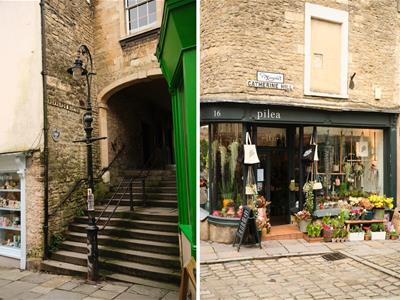
The charming town of Frome has garnered a national reputation as one of the most desirable places to live in the UK — regularly featured in The Sunday Times and other press for its creative energy, independent spirit and architectural charm. Distinct areas of historic buildings are connected by sinuous streets, elevated walkways and alleys winding up and down the hillside and providing ever changing views of the townscape. Along the way, interesting shops nestle within one of the largest collections of listed buildings in Somerset. Frome’s town centre is largely unaffected by redevelopment. Some central streets are still cobbled and many of the buildings date back to the 1700s, and as such there is a wealth of historic places of interest.
The town offers a lively collection of artisan shops, cafe´s and restaurants, as well as several supermarkets and good schooling. The Frome Festival brings a cultural vibrancy every summer, with music, art and literature events held alongside local favourites such as The Black Swan Arts Centre, the Cheese and Grain concert hall, and a charming independent cinema.
Nearby, the City of Bath (a UNESCO World Heritage Site) offers further cultural depth — famed for its classical architecture and Roman baths, as well as its galleries, theatres and first-rate schooling. Both Bath and the surrounding area offer a wide choice of highly regarded schools, including Prior Park and Monkton Combe, as well as All Hallows, Downside, Warminster, Wells Cathedral School, Bruton and Millfield.
Further attractions include the fashionable Babington House (6 miles), Bruton with the Hauser & Wirth gallery and acclaimed restaurant at The Newt (around 14 miles), and the historic town of Glastonbury, some 20 miles away. For the rambler there are excellent walks easily accessed from the house.
Transport
Transport links are excellent. Westbury and Bath Spa stations offer direct rail services to London Paddington (from 1 hour 20 minutes), while the M4 motorway is readily accessible via Junctions 17 and 18. Bristol Airport, approximately 50 minutes away, provides both domestic and international connections.
Frome Station 1.1 miles (trains to Paddington and Waterloo stations),
Warminster Station 7.4 miles (trains to London Waterloo in 2 hours),
Westbury Station 8.4 miles (direct trains to London from 1hr 20mins),
Bath 14.6 miles, Bruton 11.4 miles,
The Newt 14.5 miles, Bristol Airport 24 miles
(All distances and times approximate)
Chapters Past
Set on the eastern edge of the Mendip Hills, Frome is built on steep handsome hills around the river. Frome means ‘brisk-flowing water’ and the early town and its Market Place grew around springs. To this day, these provide continuous supplies of fresh clean water, as it has done throughout the town’s long history. This can be seen in Cheap Street, one of the best preserved medieval streets in Europe. Here, the leat winds its way down the centre of the pavement.
Founding Frome
The town dates from around the 7th century when the Abbot of Malmesbury, St Aldhelm, founded a monastery here. The monastery has long since disappeared. However, interesting religious buildings continue to dominate the skyline including St John’s Church, notable for its distinctive Via Crucis, and Rook Lane Congregational Church, which was built in 1707 and is now an arts centre.
A Centre for the Cloth Trade
Frome was an acclaimed centre for cloth production from c.1475 to 1790. John Leland (1542) describes a town of “fayre stone howsys” built on the proceeds of the cloth trade and the markets. Cloth from Frome was sold through London and exported to Europe. According to Daniel Defoe, in 1742-1747, Frome was larger than Bath.
The architecture today is illustrative of the legacy of earlier industry and trade in Frome. That architecture includes the beautiful Silk Mill in Merchant’s Barton. The Ward family, silk throwsters of Evercreech, Bruton and Shepton Mallet, constructed the building, which served as a mill, in the closing years of the 1700s. Now, it is a thriving art space, rescued by local people and lovingly brought back to life.
Although these particulars are thought to be materially correct their accuracy cannot be guaranteed and they do not form part of any contract.
Property data and search facilities supplied by www.vebra.com